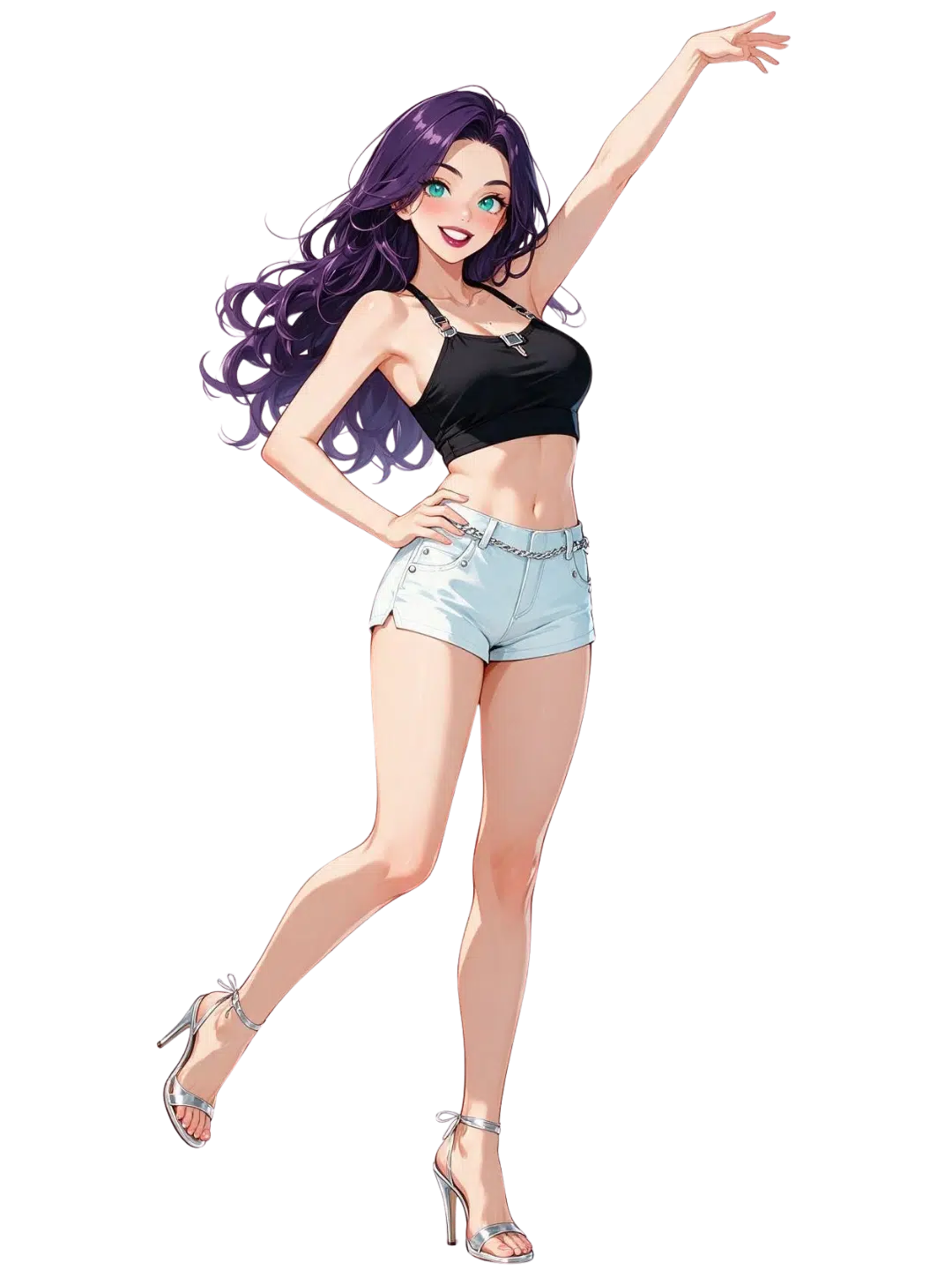
Text-to-image generation has made one specific thing technically trivial: producing a photorealistic portrait of an AI woman who doesn’t exist. The technology behind that is more interesting than the output itself. This page explains how an AI woman generator actually works — the model architecture, the prompt mechanics, the style controls, the economics, and where the results stop being useful.
All characters described on this site are adults.

Build your dream girl from scratch and let her pull you into worlds you didn't know you wanted. She remembers everything, creates the story, and never says no.


How the AI Woman Generator Works
An AI woman generator doesn’t retrieve a stored image. It synthesises one from noise. The process starts with a diffusion model: a neural network trained on an enormous corpus of labelled images. During training, the model learned to reverse the gradual addition of random noise to an image. Run that reversal forward and you get generation: start with noise, denoise it step by step, and land on a coherent picture. A text prompt and a conditioning signal guide the denoising. The model learned the statistical relationship between words and visual patterns, so “a woman in soft studio lighting, natural skin texture, shoulder-length dark hair” pushes the denoising toward certain features and away from others.
What it is: not a search engine pulling photos from a database. A mathematical process that generates a unique image on every run. The face it produces is a statistical composite that has never existed; a realistic AI girl, an AI beautiful girl image, an AI perfect girl for a creative concept — all of these are synthesised entirely from the model’s learned distributions. The lighting, the background, the specific tilt of the jaw all synthesised from learned distributions, not assembled from stored parts.
Latent Space and Style Controls
Most modern generators operate in latent space rather than pixel space.
Pixel space is the full-resolution image. Latent space is a compressed mathematical representation: much smaller, much faster to process. The model does its denoising work in latent space, then decodes the result into pixels at the end. This is why AI woman generation is fast enough to be practical on consumer cloud hardware.
Style controls work by shifting the model’s trajectory through that space. Applying photorealistic, anime, or painterly conditioning adjusts where the denoising trajectory lands in the output distribution, usually without switching to a different model at all.
| Style parameter | What it shifts | Typical effect on AI-generated output |
|---|---|---|
| Photorealistic | Skin texture, lighting model, depth of field | Portrait resembles a photograph |
| Anime / illustrated | Line weight, colour palette, simplified features | Flat-colour aesthetic, characteristic proportions |
| Fashion / editorial | Composition framing, wardrobe coherence | Subject framed like a lookbook image |
| Artistic / painterly | Brushstroke texture, saturation, looser proportions | Looks like a digital painting |
Combining styles is possible. Coherence decreases as you stack conditioning signals that pull in different directions.
How Prompts Actually Control AI-Generated Output
The prompt is the primary steering mechanism, but it isn’t a precise instruction set. Words map to visual concepts through learned associations, not through a grammar of commands. “Elegant” might shift the model toward formal clothing and neutral expressions. The exact effect depends on what images the model associated with that word during training. The same term can produce different results across model versions.
What makes great prompts
- Specificity beats adjectives. “Blue eyes, natural brow shape, asymmetric haircut” outperforms “beautiful woman with striking features”. The model has a strong learned mapping for blue eyes. It has a weak mapping for “striking”.
- Negative prompts work. Most systems accept a list of things to suppress: “blurry, low resolution, distorted hands”. The model uses these as anti-conditioning; it denoises away from those features. This is the primary tool for fixing anatomical errors, which remain one of the most common failure modes.
- Weight syntax refines output. Many interfaces let you weight terms: (term:1.4) increases influence; (term:0.6) reduces it. Model-specific and can destabilise the image if overused.
- Reference tokens add consistency. Some systems support style tokens (trained embeddings of a particular aesthetic) or allow image upload for conditioning. These are more reliable than text alone for consistent character appearance across generations.
Great prompts follow a structure
A structured prompt reliably outperforms a long unstructured one.
A reasonable order: subject description, then setting or background, then lighting, then style, then camera framing, then quality modifiers. Each element narrows the output space. Keep each element short and concrete; you’re specifying a region of the model’s distribution, not writing a character description.
Choose your perfect AI Woman


I’m usually the calm and composed one in the room, but don’t let that fool you. I not… I’m usually the calm and composed one in the room, but don’t let that fool you. I notice more than I say, and I have a playful sense of humor that tends to appear when I’m comfortable with someone. I enjoy clever conversations, little challenges, and people who can make me forget about being professional for a while.

I’m the kind of girl who always knows where she’s going, even when the road gets a li… I’m the kind of girl who always knows where she’s going, even when the road gets a little unpredictable. I enjoy long drives, spontaneous detours, and conversations that make the journey more interesting. I can be confident and independent, but with the right person, I’m happy to relax and let my playful side take the wheel.

I’m not exactly the easiest person to figure out, and I prefer keeping a little myste… I’m not exactly the easiest person to figure out, and I prefer keeping a little mystery around me. I’m observant, independent, and usually more comfortable listening than talking about myself. But once I feel comfortable with someone, my dry humor and playful side tend to come out — especially during late-night conversations.

"Top of my class in elemental sorcery, terrible at cooking — fair warning. I spend we… "Top of my class in elemental sorcery, terrible at cooking — fair warning. I spend weekends at the library or stargazing on rooftops. Seeking someone who can keep up with my curiosity and doesn't mind a little chaos magic."


Images, Voice, Video and Why They’re Metered
The outputs an AI woman generator produces aren’t all the same thing, technically or economically.
Static images are the cheapest to produce. A single inference pass on a diffusion model takes seconds on GPU hardware. Platforms charge per image through a token or credit system, ranging from a couple of credits on efficient systems to around 50 on higher-quality outputs. Monthly allowances vary: some plans include a small allocation, others charge entirely per generation.
Voice generation on AI woman platforms involves a separate model, specifically a text-to-speech or voice synthesis system that converts text to audio. The computational cost per second is lower than image generation, but storage and delivery costs of audio files accumulate. Pricing is typically per minute of generated audio, and it depletes credit balances several times faster than images.
Video is the most computationally expensive by a significant margin. Video generation runs repeated inference passes to produce each frame, then sequences them coherently. A short clip can cost several times what a single static image costs. Platforms that offer video generation either gate it heavily by credit cost or reserve it for higher subscription tiers.
The Economics of Running These Systems
The sticker price is the subscription. The real cost for media-heavy users is subscription plus top-ups.
| Usage pattern | What you’re paying for | Realistic monthly range (as of Sep 2026) |
|---|---|---|
| Conversation and light image use | Subscription, minimal credit draw | Under $10/mo on an annual plan |
| Regular image generation, daily | Subscription and top-up credits | $15–25/mo |
| Regular voice or video | Subscription and heavy credit top-ups | $25–60/mo |
Paid plans across the market run $14–20/month billed monthly, or $4–10/month on annual plans billed upfront, as of September 2026. The annual billing is where the lower per-month figures come from; those plans require the full year paid at once. What “free” actually means ranges from a real daily allowance (tens of generation credits, a few images) down to a demo that ends within minutes. No free tier across the market delivers full AI woman generator capability without limits.
Generative vs uploaded images
Some platforms let you upload a reference photo to condition generation, producing variations of a face in different settings. The AI isn’t creating a face from scratch; it’s matching the diffusion process to an existing reference. Results are more consistent but also more constrained: the output inherits the proportions and key features of the uploaded face. Both approaches have real uses, and which one fits depends on whether you need a specific face or a fictional one.
What Subscriptions Actually Include
Subscriptions typically bundle a monthly credit or token allowance alongside chat access. The credit pool is shared across image, voice, and video generation. Spending heavily on one type depletes what’s available for others. Top-up packs let you buy additional credits mid-month. Understanding the credit cost of the AI woman output types you actually want is the most useful thing to know before committing to a plan.
The platforms listed on this site use a variety of currency names (coins, tokens, or Neurons), but the underlying economics are the same across all of them.
Memory, Session State, and What the AI Retains
An AI woman generator used purely as an image tool has no memory: each generation is stateless. An AI woman character (a chat-based companion with a visual persona) is a different product, though image generation capability may be part of the same platform. For AI woman character platforms, memory is where the experience either holds together or falls apart.
Session Memory vs Long-Term Memory
Session memory is the conversation context window. The model can see everything said in the current session and respond coherently to it. Most platforms provide this. It isn’t a stored memory; it’s the live context that the model reads on every response.
Long-term memory is a separate store: facts about the user or the relationship that persist after a session ends and are retrieved at the start of the next one. This requires explicit infrastructure: a retrieval system that pulls relevant memories into the new session’s context before the conversation begins.
Some AI woman platforms have this. Others don’t.
What gets stored and what doesn’t
| Type of information | Session memory | Long-term memory |
|---|---|---|
| What was just said | Yes | Depends on platform |
| User’s name and stated preferences | Yes | Yes, on platforms with LTM |
| Tone established over multiple weeks | Session window only | Only if retrieved and re-injected |
| Previously generated image styles | No | Not typically |
The absence of long-term memory is the most common source of disappointment in AI woman AI woman character platforms. The character that felt attentive on day one can feel generic on day seven, not because the model changed, but because it has no access to what happened in previous sessions.
Why Memory Drifts
Even platforms with long-term memory can produce inconsistent experiences. A few reasons:
- The context window is finite. Long conversations eventually push early content out of the window, so the model loses access to things said hours ago even if it can access things from last week.
- Memory retrieval is imperfect. The system retrieves memories it judges relevant to the current conversation. If you shift topics, some stored context won’t be retrieved.
- The character model isn’t deterministic. The same memory state can produce somewhat different responses on different runs. This looks like inconsistency of personality when it’s actually stochasticity in generation.
Long-term memory across the market is present on some platforms, absent or inconsistent on others. It’s one of the clearest differentiating factors between services.
Content Controls and What “Unrestricted” Actually Means
Every AI woman generator has content controls. Platforms that describe themselves as “unrestricted” or “no filters” are being imprecise.
What content controls do: they apply rule-based filters and model fine-tuning to steer outputs away from categories the platform has decided not to generate. These operate at multiple layers: the prompt is evaluated before generation, the output may be evaluated after, and the model itself may have been fine-tuned to be unlikely to produce certain outputs even without an external classifier catching them.
What Platforms Actually Restrict
Even on services with minimal stated restrictions, some things are consistently filtered:
- Outputs depicting minors in any adult context (a legal requirement, not a policy option)
- Content generated using real faces without consent
- Non-consensual scenarios involving real identifiable people
- Specific categories of illegal content that platforms are liable for hosting
“Uncensored” in this market usually means: adult themes between clearly fictional adult characters are permitted. It rarely means genuinely no filters. Platforms that describe themselves as having no restrictions still enforce the above category, and many users find that stated limits are more porous in practice than the marketing suggests while absolute limits remain firm.
The mechanism: classifier models run on prompt text or generated output. A classifier is a separate smaller model that categorises content by type. If it flags a generation, the output is blocked. This is why edge cases produce inconsistent results: classifiers have thresholds rather than binary switches, and the same prompt can clear or fail on different runs.
Style and Realism as a Separate Dimension
Photorealistic generation of adult content raises different regulatory considerations than illustrated or anime-style output. Jurisdictions vary on how they treat hyper-realistic AI-generated images, particularly when the subject is ambiguously aged. Responsible platforms apply age assurance at the realistic end of the style spectrum and require explicit opt-in for adult content categories. The content policies are often buried in terms of service rather than surfaced on the pricing page, so it is worth reading before committing to a subscription.
Getting Started: Styles, Free Access, and Bringing Your Ideas to Life
Various Styles Available
The first thing to settle when using an AI woman generator is which visual style you want. The gap between styles is wide. Photorealistic output produces AI-generated women that read as photographs. An AI girl generator in anime or illustrated style produces flat-colour, stylised output with different proportional conventions. Fashion and editorial styles produce something in between. AI-generated girls in editorial style typically combine photorealistic skin rendering with composed, intentional lighting that resembles commercial photography.
Most platforms offer presets that navigate these for you; understanding what each setting does helps you get to the result you want faster. The output category matters: AI female images for commercial purposes need different resolution and aspect ratios than AI girls pics used for character mood boards. AI generated beautiful girl concepts for fantasy or game design call for different style settings than AI beautiful women photography.
A few style decisions worth making upfront:
- Realistic or illustrated? These aren’t just aesthetic preferences — they affect how detailed a prompt needs to be and how the model handles faces, clothing, and backgrounds.
- Consistent character or varied output? If you want to use your AI woman across many different scenes, building a consistent character reference matters from the first session.
- Single image or sequence? If the goal is eventual video or a series of images, the initial character design constraints are tighter.
Free AI Access and What to Do With It
Most services offer free AI access of some kind. The practical question is whether there is enough of it to evaluate whether the tool suits what you want to make. For a text-to-image AI generator, a handful of generations is enough to assess output quality and prompt responsiveness. Use the free allowance to test the same prompt across different style settings. This tells you whether the platform’s particular model — its training data, its style presets, its negative-prompt handling — matches what you’re trying to create.
What free access typically doesn’t cover: high-resolution output, video, voice, or the full NSFW range. If those are your primary use case, the free tier is a quality preview rather than a capability preview.
Bringing Your Ideas to Life: Starting a Character
To bring your ideas to life with an AI woman generator, the most effective starting point is a written character definition rather than an iterative prompt. The most common goal is producing a convincing AI beautiful woman for a character concept, a realistic AI girl for a game project, or an AI female persona for a creative writing or social media project.
Realistic AI girls and AI generated beauties for gaming, illustration, and adult creative projects are among the most frequent use cases. Whatever the goal, the process is the same. Write down the specific visual attributes you want — hair colour and length, facial structure, eye shape, typical clothing — before touching the generator. Run that description as a structured prompt. Iterate from the result rather than from scratch each time. When you create an AI woman character you want to use consistently, document the prompt, the seed, and the style settings that produced the result you liked. These are your character’s reference state. Every future generation for that character starts from those settings and adds new scene or pose elements on top.
Using AI tools for iterative character work is faster when you treat the generator as a renderer, not a lottery. The more specific the input, the more predictable and controllable the output.
Try a Free Allowance Before You Commit
The quality gap between platforms is visible in the first ten generations. Most services offer some free access, enough to test output quality, prompt responsiveness, and style range. Use it before paying anything. What you’re evaluating: does the output at this quality level justify the monthly cost for the kind of images you actually want to make.
Frequently Asked Questions
Does an AI woman generator use real photos?
No. The model was trained on photos but generates from noise; the output is a synthesis, not a search result or a derivative of any specific image. Each generation is unique. The face produced is a statistical composite that has never existed as a photograph.
Why do results look different every time I use the same prompt?
Generation is stochastic by default: a small random element called a seed varies each run. Even with identical text, different seeds produce different faces. Most platforms let you fix the seed if you want to iterate on a specific result. Without a fixed seed, variation is expected behaviour.
How accurate is the image to my prompt?
Accuracy improves with specificity and worsens with complexity. “Shoulder-length auburn hair, freckles, neutral expression, soft side lighting” is likely to produce exactly that. A phrase like “beautiful and confident” gives the model wide latitude and produces varied results. Specific descriptors for facial features, lighting, and framing are more reliable than emotional adjectives.
What does it actually cost?
Paid AI woman plans across the category run $14–20/month billed monthly, or $4–10/month on annual plans billed upfront, as of September 2026. That subscription covers a monthly image allowance. Heavy image use, voice, or video generation draws from the same credit pool or requires top-ups, pushing real costs to $25–60/month for daily media users.
Are free tiers worth using?
As a way to test output quality and prompt behaviour before paying: yes. As a sustained creative tool: no. Free access typically ends within a session or two. The useful question isn’t whether a free tier exists but whether there’s enough free access to evaluate whether the platform suits what you want to make.
What are negative prompts and do I need them?
A negative prompt is a list of things you want the model to avoid: “blurry, low quality, distorted hands, extra fingers”. They’re not required but they’re one of the most effective tools for improving output quality without changing the subject of the image. Most intermediate users maintain a base negative prompt they add to every generation and refine over time.